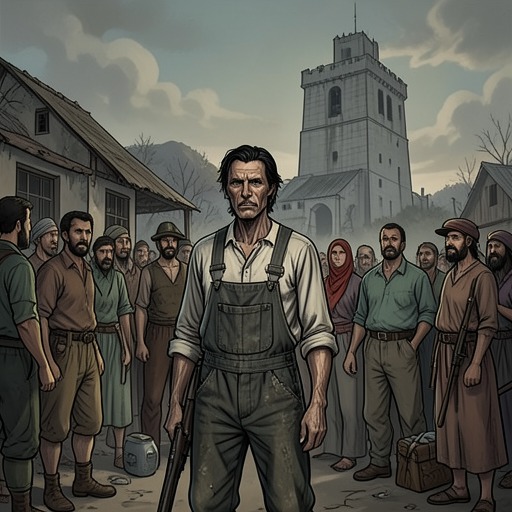
Bourbon reconquest of Sicily (1849)
The Florios of SicilyThe Bourbon reconquest of Sicily in 1849 is the restoration of Bourbon rule after the revolution, a political defeat that reaches into the Florio family’s private life. As the revolutionary government falters and Palermo faces surrender, the family takes refuge aboard a ship; through ten-year-old Ignazio’s perspective, the return of Bourbon power becomes a child’s first understanding that home, comfort, and security can disappear.
Causes and political setting
The reconquest follows the upheaval of 1848, when the Bourbons were driven out and a new government took power. The revolutionary year had already entangled the Florios in the uncertain politics of the island: Vincenzo says he bought a large consignment of rifles on behalf of the revolutionary committee, while the emerging Kingdom of Sicily lacked a king willing to accept its crown. He also describes British opposition to Sicily’s separation from the Bourbons and the attempt to restore the 1812 constitution without a stable political point of reference.
By 1849 the revolutionary cause was losing ground. Ignazio hears that Taormina, Catania, Siracusa, and Noto surrendered in early April, and understands that Palermo may be next, though no one explains the military and political developments to him. The narrative makes the distance between political events and a child’s understanding part of the crisis: he knows the year has been complicated and his father unusually tense, but not what the outcome will mean.
Flight and the surrender of Palermo
The Florio family leaves first its house in Via dei Materassai and then Villa dei Quattro Pizzi. They relocate to L’Indépendant, a steamship Vincenzo had bought for his shipping venture with Ignazio. The vessel is presented as a refuge because it is registered as French; Vincenzo believes neither the rebels nor the Neapolitans will attack it for fear of provoking France. The family’s safety thus depends on a commercial asset and on the protection its foreign registration may afford.
From the ship, Ignazio watches the closed villa and the apparently deserted village of Arenella through a sailor’s telescope. At ten, he recognizes that circumstances have taken away the certainties, comfort, and well-being he had treated as permanent. His fear differs from the terror of nearly dying: it comes from seeing that the family’s whole way of life can be uprooted. At night, thin cabin walls allow him to hear his parents; after the rustle of his mother’s dress, silence leaves him listening to his own heartbeat and the water against the ship.
The military and civic crisis reaches its formal turning point when prominent citizens of Palermo meet Carlo Filangeri, commander of the Bourbon army, at Caltanissetta and hand over the city’s surrender. But the decision of the delegation does not settle the city’s response. The people refuse to accept surrender, rise against the city guard, and erect barricades, shouting, “No concessions to the Bourbons, never!” Hunger has not overcome their hostility to Neapolitan rule. The episode therefore holds official capitulation and popular resistance side by side rather than treating the city’s submission as uncomplicated consent.
Consequences for the Florios and Sicily
The reconquest leaves the family displaced and its security precarious. Ignazio looks at his mother and notices dark rings beneath her eyes, wrinkles around her mouth, and lines on her forehead; he reads the marks as signs of fear and of what the crisis has done to her. The political defeat becomes legible not only in surrendered cities but in a face, a closed villa, and a family confined aboard a ship.
The return of Bourbon power also frames the later political and commercial pressures placed on Vincenzo. After the reconquest, Carlo Filangeri sits in an elegant Palermo office amid the trappings of restored authority, while letters record a bitter dispute between Vincenzo and Pietro Rossi. The narrative recalls that Filangeri had sought Vincenzo’s appointment as negotiations manager at the Royal Bank in 1850, viewing the merchant’s commercial reach as potentially useful to the kingdom’s administration. Political authority and business interests remain closely joined: Florio shipping, finance, and trade make the family valuable to rulers, but also expose its assets to demands from governments and armies.
That tension recurs in Vincenzo’s later account of the 1848 crisis. He says trade fell by half after the revolt began and that the revolutionary regime took the Sicilian Steamship Company’s vessel Palermo to transport troops. Much later, objecting to the post-unification annexation of Sicily, he argues that the Piedmontese are turning the island into a colony and that the Bourbon treasury has been carried north to pay for annexation. These later complaints do not undo the reconquest; they show how the novel places successive changes of rule against the merchant’s fear that political projects will claim the wealth and structures he has built.
Narrative significance
The episode is filtered through overlapping scales of experience: the retreat of the revolution, the surrender negotiations, the citizens’ resistance, and a child’s discovery of vulnerability. Ignazio cannot explain the conflict, but the telescope, the emptied-looking Arenella, and the family’s forced move give its consequences a concrete form. The reconquest marks not just a transfer of military power but a break in the Florios’ ordinary sense of home, and it foreshadows the continuing contest between Sicily’s political fate and the family’s commercial independence.